
Dropped Bifold Door? Signs, Causes and the Repair
Repairs · 18 October 2026 · Kieran Myers
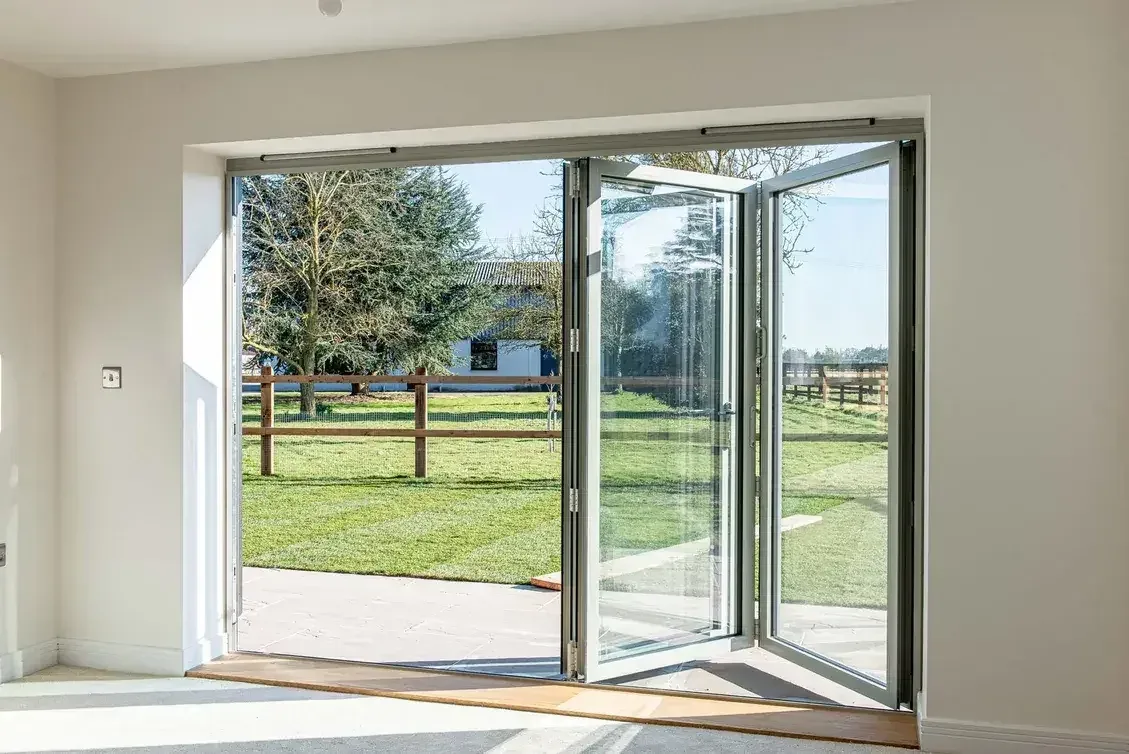
A bifold door has dropped when one or more of its panels has sagged out of line with the frame. You notice it as a door that scrapes along the threshold, catches as it folds, takes a shove to close, or won't let the handle turn far enough to lock. The usual causes are grit in the track, worn rollers, hinges that have worked loose and packing under the frame that has shifted, and all of those are repairs. None of them on its own means the doors need replacing.
The one cause that isn't a door repair is the opening itself. If the beam or lintel above the doors has sagged, it presses down on the frame and no amount of adjustment will hold for long. Before anyone touches the hinges, find out which of these you are dealing with. The signs usually tell you.
How a bifold door carries its weight
A set of bifolds is a row of glazed panels hinged together, running on rollers in a track. In a bottom-rolling system the weight sits on the track at the foot of the frame, and the head track only guides the panels. In a top-hung system the panels hang from rollers in the head, so the beam above the doors carries their weight. Most sets also have a traffic door, the single panel you open for everyday use, which swings on its own hinges like an ordinary door before the rest fold back.
The hinges and roller carriages on most modern systems can be adjusted in small steps, up and down and side to side. That adjustment is what lets a fitter set the panels square on the day, and it is also what lets them drift as screws loosen and parts wear. Because the panels are linked, one that drops pulls on the panels next to it.
The signs that a panel has dropped
Look at the doors closed, from inside, in good light. The gaps where the panels meet should be even from top to bottom. A gap that is wide at the top and tight at the bottom, or the reverse, means a panel is leaning.
Then work the doors and listen. These are the most common signs.
A scraping sound, or a bright line worn into the threshold or the bottom track
Panels that catch on each other or on the frame as they fold
A traffic door that rubs on the frame or has to be lifted to close
A handle that is stiff to turn, or a lock that won't engage at all
Daylight at the top corner of a panel, or a draught along the bottom
Water on the floor inside after rain, where the bottom seal no longer meets the threshold
The lock is the part most sensitive to a drop. Bifolds usually lock at several points along the frame, and when a panel drops even a few millimetres the bolts no longer line up with the keeps they are meant to slide into.
Why bifold doors drop
Dirt is the simplest cause. Leaves, grit and small stones collect in the bottom track and the drainage channels, and the rollers ride up over them. The advice on our bi-fold doors page for keeping them running smoothly is to keep the tracks and drainage channels free of debris and to check the rollers, hinges and hardware now and then.
Worn rollers come next. A roller that has flattened, cracked or seized lets its panel sit lower than the rest, and doors that are opened every day wear them faster.
Hinges and fixings work loose with use, and a panel will gradually sink on its hinges if they aren't adjusted. This often shows first on the traffic door, which hangs from hinges on one side like an ordinary door.
The frame has to start out level and square, too. The UK manufacturer Origin tells installers in its guide to fitting bifold doors to leave a fitting tolerance of at least 5mm on all sides and to set packers along the opening so the track sits on a level, stable platform. If that packing was never right, or has crushed or moved, the track bows and the panels follow it.
The last cause is the structure above. A wide opening is usually spanned by a steel beam or lintel, and every beam bends slightly under load. For its own doors, Origin specifies a maximum deflection of 3mm. If a beam bends more than the doors can tolerate, the head of the frame is pushed down, pinching the panels so they bind. Top-hung doors are the most sensitive to this because they hang from the head, but any bifold can be squeezed by a sagging beam. Cracks in the plaster above the opening, or doors that have got steadily worse since an extension went up, point to it. That is a matter for a builder or a structural engineer, and adjusting the doors will only hide it for a while.
What you can safely check yourself
Start with the track. Vacuum the bottom track and the drainage slots, pick out any stones, and wipe the running surfaces clean. Run the doors again. If the scraping has gone, that may be all it was.
Check the visible screws on the hinges and handles, and tighten any that have worked loose with the right size of screwdriver. Don't force a door that is binding, because the strain goes into the hinges, the rollers and the glass.
We would leave the hinge and roller adjustment to someone who knows the system. Each make adjusts differently, some need special tools, and because the panels are linked, moving one can throw out the others. If you do try, follow the manufacturer's instructions for your exact doors, and lubricate only with what they recommend, as some tracks are meant to run dry.
What the repair involves
A repair starts with finding out which part has moved, from the gaps between the panels, the wear on the track, the state of the hinges and rollers, the beam above and whether the frame is still level. That shows whether the doors need adjusting, new parts or both.
The panels are then lifted back into line on their hinges and carriages, worn rollers and hinges are replaced, packing is corrected where the track has bowed, and the keeps are reset so the lock engages properly again. Our repairs service covers bi-fold doors alongside composite, uPVC and aluminium doors, and we fix locks, handles, rollers and door alignments on all of them.
Sometimes it comes up alongside other work. In August 2026 we fitted a customer's new front door, and while we were there we also fixed their dropped bifold door, which they wrote in their review had been difficult to open and close.
Where a door has been forced for a while, check the glass as well. Bifold panels are large, and the building regulations for doors and windows treat glazing in a door up to 1500mm from the floor as a critical area, so a replacement pane should be safety glass. A panel that has misted between the panes can usually be replaced on its own, without the door, just as misted double glazing is in a window.
Is a dropped bifold urgent?
It is if the doors won't lock. A bifold that can't be secured is an open door at the back of the house, and it should be sorted quickly. Where the traffic door locks with a key cylinder, as many do, the cylinder deserves the same attention as one on a front door, and the anti-snap cylinder standards that matter for the most secure front door apply here too.
If the doors still lock but are stiff, it is less pressing, but it won't improve on its own. Every time a dropped panel is dragged across the track the wear gets worse, and the repair grows from an adjustment into new parts.
Repair or replace?
Replace only when the doors themselves have failed, which means frames that are bent or twisted, parts that can no longer be found and have no workable substitute, or doors that were badly made or the wrong size for the opening from the start. Even when the original parts are no longer made, an alternative can often be made to work. That is how we fixed a customer's bathroom window this summer, after it had stopped locking and the parts it needed turned out to be obsolete, and the same applies to a window that won't lock for any other reason.
When replacement does make sense, the opening is worth a second thought. Bifolds open almost the whole width to the garden, but for a narrower opening, or a room where you want to keep the wall either side, French doors can be the simpler answer.
If your bifold doors are dragging, sticking or won't lock, send us a short video on WhatsApp or contact us at KM Glazing, and we will tell you whether it is an adjustment, new parts or something in the opening that needs looking at first.
